 Home
About
Contact
Home
About
Contact
Jupiter has a long history surprising scientists—all the way back to 1610 when Galileo Galilei found the first moons beyond Earth. That discovery changed the way we see the universe.Fifth in line from the Sun, Jupiter is, by far, the largest planet in the solar system – more than twice as massive as all the other planets combined.
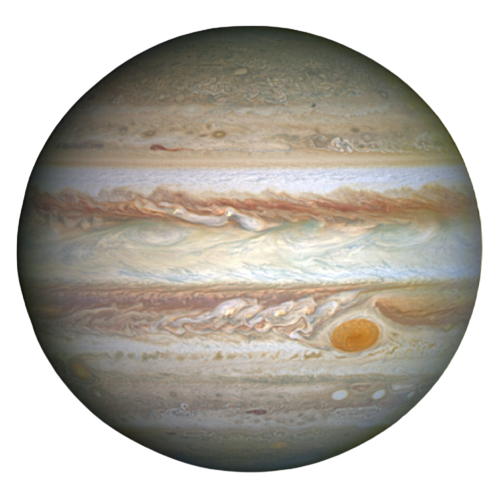
Jupiter's familiar stripes and swirls are actually cold, windy clouds of ammonia and water, floating in an atmosphere of hydrogen and helium. Jupiter’s iconic Great Red Spot is a giant storm bigger than Earth that has raged for hundreds of years. Jupiter is a gas giant and doesn't have a solid surface, but it may have a solid inner core about the size of Earth. Jupiter also has rings, but they're too faint to see very well. One spacecraft — NASA's Juno orbiter — is currently exploring this giant world.
There are no rockets powerful enough to hurl a spacecraft into the outer solar system and beyond. In 1962, scientists calculated how to use Jupiter's intense gravity to hurl spacecraft into the farthest regions of the solar system. We've been traveling farther and faster ever since.
The biggest planet in our solar system, Jupiter also has a large presence in pop culture, including many movies, TV shows, video games and comics. Jupiter was a notable destination in the Wachowski siblings’ science fiction spectacle Jupiter Ascending, while various Jovian moons provide settings for Cloud Atlas, Futurama, Power Rangers, and Halo, among many others.
| Planet Profile | |
|---|---|
| Equatorial Diameter: | 142,984 km |
| Polar Diameter: | 133,709 km |
| Mass: | 1.90 x 10^27 kg (318 Earths) |
| Moons: | 79 (Including Io, Europa, & Ganymede) |
| Rings: | 4 |
| Orbit Distance: | 778,340,821 km km (5.20 AU) |
| Orbit Period: | 4,333 days (11.9 years) |
| Surface Temperature: | -108°C |
| First Record: | 7th or 8th Century BC |
| Recorded By: | Babylonian astronomers |
Eleven Earths could fit across Jupiter’s equator. If Earth were the size of a grape, Jupiter would be the size of a basketball.
Jupiter orbits about 484 million miles (778 million kilometers) or 5.2 Astronomical Units (AU) from our Sun (Earth is one AU from the Sun).
Jupiter rotates once about every 10 hours (a Jovian day), but takes about 12 Earth years to complete one orbit of the Sun (a Jovian year).
Jupiter is a gas giant and so lacks an Earth-like surface. If it has a solid inner core at all, it’s likely only about the size of Earth.
Jupiter's atmosphere is made up mostly of hydrogen (H2) and helium (He).
Jupiter has more than 75 moons.
In 1979 the Voyager mission discovered Jupiter’s faint ring system. All four giant planets in our solar system have ring systems.
Nine spacecraft have visited Jupiter. Seven flew by and two have orbited the gas giant. Juno, the most recent, arrived at Jupiter in 2016.
Jupiter cannot support life as we know it. But some of Jupiter's moons have oceans beneath their crusts that might support life.
Jupiter's Great Red Spot is a gigantic storm that’s about twice the size of Earth and has raged for over a century.