 Home
About
Contact
Home
About
Contact
The first planet found with the aid of a telescope, Uranus was discovered
in 1781 by astronomer William Herschel, although he originally thought it
was either a comet or a star. It was two years later that the object was
universally accepted as a new planet, in part because of observations by
astronomer Johann Elert Bode. Herschel tried unsuccessfully to name his
discovery Georgium Sidus after King George III. Instead the scientific
community accepted Bode's suggestion to name it Uranus, the Greek god of
the sky, as suggested by Bode.
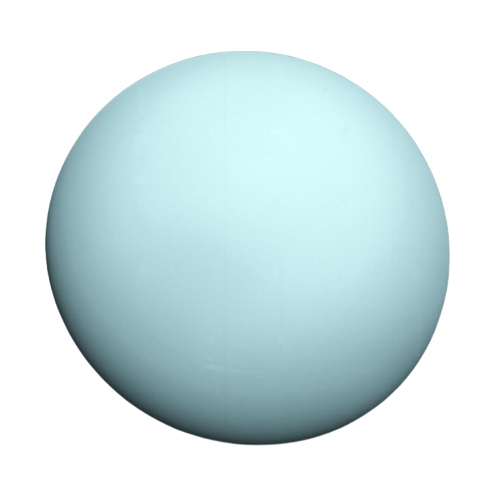
Uranus is an Ice Giant planet and nearly four times larger than Earth.
It has 27 known moons, most of which are named after literary characters,
and like Saturn, Jupiter and Neptune, Uranus is a ringed planet.
Uranus' unique sideways rotation makes for weird seasons. The planet's north pole experiences 21 years of nighttime in winter, 21 years of daytime in summer and 42 years of day and night in the spring and fall.
Uranus is the "butt" of more than a few jokes and witty (and not so witty) puns, but it's also a frequent destination in various fictional stories, such as the video game Mass Effect and TV shows like Doctor Who. The radioactive element uranium was named after Uranus when it was discovered in 1789, just eight years after the planet was discovered.
| Planet Profile | |
|---|---|
| Equatorial Diameter: | 51,118 km |
| Polar Diameter: | 49,946 km |
| Mass: | 8.68 x 10^25 kg (15 Earths) |
| Moons: | 27 (Including Miranda, Titania & Ariel) |
| Rings: | 13 |
| Orbit Distance: | 2,870,658,186 km (19.22 AU) |
| Orbit Period: | 30,687 days (84.0 years) |
| Surface Temperature: | -197°C |
| Discovery Date: | March 13th 1781 |
| Discovered By: | William Herschel |
Uranus is about four times wider than Earth. If Earth were a large apple, Uranus would be the size of a basketball.
Uranus orbits our Sun, a star, and is the seventh planet from the Sun at a distance of about 1.8 billion miles (2.9 billion kilometers).
Uranus takes about 17 hours to rotate once (a Uranian day), and about 84 Earth years to complete an orbit of the Sun (a Uranian year).
Uranus is an ice giant. Most of its mass is a hot, dense fluid of "icy" materials – water, methane and ammonia – above a small rocky core.
Uranus has an atmosphere made mostly of molecular hydrogen and atomic helium, with a small amount of methane.
Uranus has 27 known moons, and they are named after characters from the works of William Shakespeare and Alexander Pope.
Uranus has 13 known rings. The inner rings are narrow and dark and the outer rings are brightly colored.
Voyager 2 is the only spacecraft to fly by Uranus. No spacecraft has orbited this distant planet to study it at length and up close.
Uranus cannot support life as we know it.
Like Venus, Uranus rotates east to west. But Uranus is unique in that it rotates on its side.