
 Home
About
Contact
Home
About
Contact
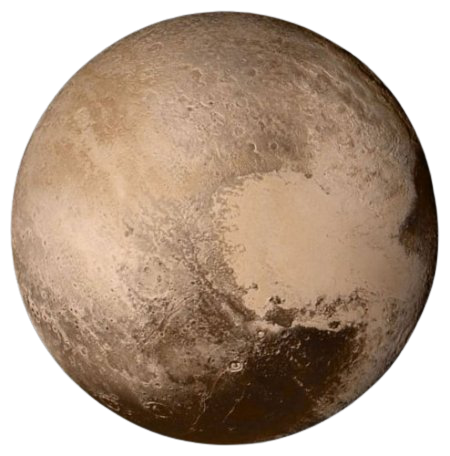
Pluto – which is smaller than Earth’s Moon – has a heart-shaped glacier that’s
the size of Texas and Oklahoma. This fascinating world has blue skies, spinning
moons, mountains as high as the Rockies, and it snows – but the snow is red. Pluto
takes an oval-shaped path with the Sun nowhere near its center. What's more, its
path is quite tilted compared to the planets.
On July 14 2015, NASA’s New Horizons spacecraft made its historic flight through
the Pluto system – providing the first close-up images of Pluto and its moons and
collecting other data that has transformed our understanding of these mysterious
worlds on the solar system’s outer frontier. In the years since that groundbreaking
flyby, nearly every conjecture about Pluto possibly being an inert ball of ice has
been thrown out the window or flipped on its head.
When Pluto was reclassified in 2006 from a planet to a dwarf planet, there was
widespread outrage on behalf of the demoted planet. As the textbooks were updated,
the internet spawned memes with Pluto going through a range of emotions, from anger
to loneliness. But since the release of New Horizons images showing a very prominent
heart-shaped feature on the surface, the sad Pluto meme has given way to a very content,
loving Pluto that would like to once again be visited by a spacecraft.
The Disney cartoon character Pluto, Mickey's faithful dog, made his debut in 1930,
the same year Tombaugh discovered the dwarf planet. There is speculation that Walt
Disney named the animated dog after the recently discovered planet to capitalize on
its popularity, but other accounts are less certain of a direct link.
| Planet Profile | |
|---|---|
| Diameter: | 2,372 km |
| Mass: | 1.31 x 10^22 kg (0.17 Moons) |
| Orbit Distance: | 5,874,000,000 km (39.26 AU) |
| Orbit Period: | 248.0 years |
| Surface Temperature: | -229°C |
| Moons: | 5 (Including Charon) |
| Discovery Date: | February 18th 1930 |
| Discovered By: | Clyde W. Tombaugh |
Pluto is about 1,400 miles (2,380 km) wide. That's about half the width of the United States, or 2/3 the width of Earth's moon.
Pluto orbits the Sun about 3.6 billion miles (5.8 billion km) away on average, about 40 times as far as Earth, in a region called the Kuiper Belt.
A year on Pluto is 248 Earth years. A day on Pluto lasts 153 hours, or about 6 Earth days.
Pluto is officially classified as a dwarf planet.
Pluto has a thin atmosphere of nitrogen, methane and carbon monoxide. The atmosphere has a blue tint and distinct layers of haze.
Pluto has 5 moons. The largest, Charon, is so big that Pluto and Charon orbit each other like a double planet.
Pluto has no ring system.
The only spacecraft to visit Pluto is NASA’s New Horizons, which passed close by in July 2015.
Pluto’s surface is far too cold, -378 to -396 degrees F (-228 to -238 C), to sustain life as we know it.
Venetia Burney, just 11 years old at the time, suggested the name Pluto in 1930.