 Home
About
Contact
Home
About
Contact
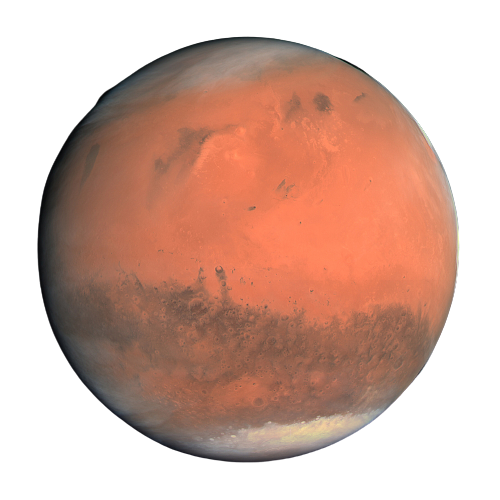
Mars is the fourth planet from the Sun – a dusty, cold, desert world with a very thin atmosphere. Mars is also a dynamic planet with seasons, polar ice caps, canyons, extinct volcanoes, and evidence that it was even more active in the past.
Mars is one of the most explored bodies in our solar system, and it's
the only planet where we've sent rovers to roam the alien landscape.
NASA currently has two rovers (Curiosity and Perseverance), one lander
(InSight), and one helicopter (Ingenuity) exploring the surface of Mars.
Perseverance rover – the largest, most advanced rover NASA has sent to
another world – touched down on Mars on Feb. 18, 2021, after a 203-day
journey traversing 293 million miles (472 million kilometers). The Ingenuity
helicopter rode to Mars attached to the belly of Perseverance.
Perseverance is one of three spacecraft that arrived at Mars in 2021.
The Hope orbiter from the United Arab Emirates arrived on Feb. 9, 2021.
China’s Tianwen-1 mission arrived on Feb. 10, 2021, and includes an orbiter,
a lander, and a rover. Europa and India also have spacecraft studying Mars
from orbit.
In May 2021, China became the second nation to ever land successfully
on Mars when its Zhurong Mars rover touched down.
An international fleet of eight orbiters is studying the Red Planet from
above including three NASA orbiters: 2001 Mars Odyssey, Mars Reconnaissance
Orbiter, and MAVEN.
These robotic explorers have found lots of evidence that Mars was much
wetter and warmer, with a thicker atmosphere, billions of years ago.
No other planet has captured our collective imagination quite like Mars. In the late 1800s when people first observed the canal-like features on Mars' surface, many speculated that an intelligent alien species resided there. This led to numerous stories about Martians, some of whom invade Earth.
| Planet Profile | |
|---|---|
| Equatorial Diameter: | 6,792 km |
| Polar Diameter: | 6,752 km |
| Mass: | 6.39 x 10^23 kg (0.11 Earths) |
| Moons: | 2 (Phobos & Deimos) |
| Orbit Distance: | 227,943,824 km (1.38 AU) |
| Orbit Period: | 687 days (1.9 years) |
| Surface Temperature: | -87 to -5°C |
| First Record: | 2nd Millennium BC |
| Recorded By: | Egyptian astronomers |
If the Sun were as tall as a typical front door, Earth would be the size of a dime, and Mars would be about as big as an aspirin tablet.
Mars orbits our Sun, a star. Mars is the fourth planet from the Sun at an average distance of about 228 million km (142 million miles) or 1.52 AU.
One day on Mars takes a little over 24 hours. Mars makes a complete orbit around the Sun (a year in Martian time) in 687 Earth days.
Mars is a rocky planet. Its solid surface has been altered by volcanoes, impacts, winds, crustal movement and chemical reactions.
Mars has a thin atmosphere made up mostly of carbon dioxide (CO2), argon (Ar), nitrogen (N2), and a small amount of oxygen and water vapor.
Mars has two moons named Phobos and Deimos.
There are no rings around Mars.
Several missions have visited this planet, from flybys and orbiters to rovers on the surface.The first true Mars mission success was the Mariner 4 flyby in 1965.
At this time, Mars' surface cannot support life as we know it. Current missions are determining Mars' past and future potential for life.
Mars is known as the Red Planet because iron minerals in the Martian soil oxidize, or rust, causing the soil and atmosphere to look red.