 Home
About
Contact
Home
About
Contact
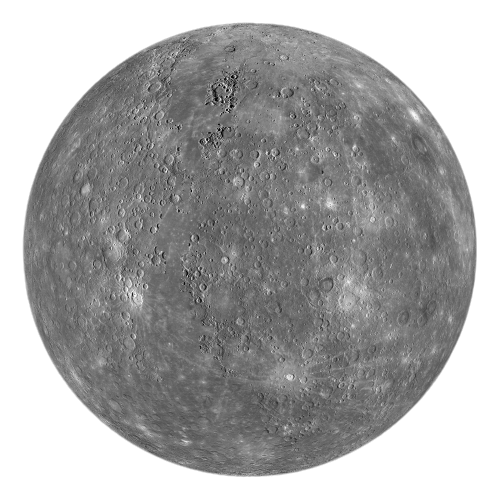
Mercury is the closest planet to the Sun and due to its proximity it is not easily seen except during twilight. For every two orbits of the Sun, Mercury completes three rotations about its axis and up until 1965 it was thought that the same side of Mercury constantly faced the Sun. Thirteen times a century Mercury can be observed from the Earth passing across the face of the Sun in an event called a transit.
Because of Mercury's elliptical—egg-shaped—orbit and sluggish rotation, the morning Sun appears to rise briefly, set, and rise again from some parts of the planet's surface. The same thing happens in reverse at sunset.
The smallest planet in our solar system has a big presence in
our collective imagination. Scores of science fiction writers
have been inspired by Mercury, including Isaac Asimov, C. S. Lewis,
Ray Bradbury, Arthur C. Clarke, and H. P. Lovecraft. Television
and film writers, too, have found the planet an ideal location
for storytelling. In the animated television show Invader Zim,
Mercury is turned into a prototype giant spaceship by the extinct
Martians. And in the 2007 film Sunshine, the Icarus II spacecraft
goes into orbit around Mercury to rendezvous with the Icarus I.
In the comic strip Calvin and Hobbes, Calvin and his classmate Susie
give a presentation about Mercury, in which Calvin's contribution
is full of questionable information: "The planet Mercury was named
after a Roman god with winged feet," says Calvin. "Mercury was the
god of flowers and bouquets, which is why today he is a registered
trademark of FTD florists. Why they named a planet after this guy,
I can't imagine."
| Planet Profile | |
|---|---|
| Diameter: | 4,879 km |
| Mass: | 3.29 x 10^23 kg (0.06 Earths) |
| Moons: | None |
| Orbit Distance: | 57,909,227 km (0.39 AU) |
| Orbit Period: | 88 days |
| Surface Temperature: | -173 to 427°C |
| First Record: | 14th Century BC |
| Recorded By: | Assyrian astronomers |
Mercury is the smallest planet in our solar system — only slightly larger than Earth's Moon.
It is the closest planet to the Sun at a distance of about 36 million miles (58 million kilometers) or 0.39 AU.
One day on Mercury (the time it takes for Mercury to rotate or spin once with respect to the stars) takes 59 Earth days. One day-night cycle on Mercury takes 175.97 Earth days. Mercury makes a complete orbit around the Sun (a year in Mercury time) in just 88 Earth days.
Mercury is a rocky planet, also known as a terrestrial planet. Mercury has a solid, cratered surface, much like the Earth's moon.
Mercury's thin atmosphere, or exosphere, is composed mostly of oxygen (O2), sodium (Na), hydrogen (H2), helium (He), and potassium (K). Atoms that are blasted off the surface by the solar wind and micrometeoroid impacts create Mercury's exosphere.
Mercury has no moons.
There are no rings around Mercury.
No evidence for life has been found on Mercury. Daytime Temperatures can reach 430 degrees Celsius (800 degrees Fahrenheit) and drop to -180 degrees Celsius (-290 degrees Fahrenheit) at night. It is unlikely life (as we know it) could survive on this planet.
Standing on Mercury's surface at its closest approach to the Sun, our star would appear more than three times larger than it does on Earth.
The two spacecraft of ESA-JAXA's BepiColombo are en route to Mercury. NASA's Mariner 10 was the first mission to explore Mercury. NASA's MESSENGER was the first to orbit the innermost planet.